



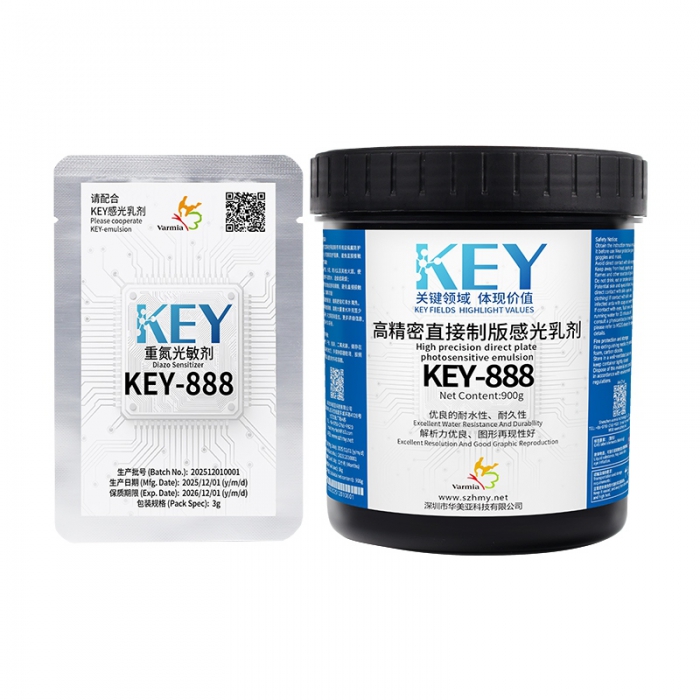
KEY-888 High-Precision Direct-Filming Photoresist
Performance Characteristics
| Compliant with Rohs Environmental Regulations | Excellent Solvent Resistance | High Sensitivity, Short Exposure Time |
| High Resolution, Fine Line Definition | Possesses Excellent Storage Stability | Easy to Remove, Screen Plates Are Easily Reusable |
Product Application Scope
KEY-888 High-Precision Direct-to-Plate Photoresist, blue in color, is a solvent-resistant, ultra-high-sensitivity photoresist specifically designed for direct-to-plate applications. Featuring exceptional sensitivity, it must be used under yellow light exposure. This product is suitable for high-definition printing, halftone printing, PCB manufacturing, electronic products, and solvent-based inks.
Product Characteristics
| Appearance | Emulsion Weight | Packaging Specifications | Solid Content | Viscosity (mPa·s) Type B Viscosity at 25°C |
| Blue Viscous Emulsion | 900 g | 1 kg | 40% | 9000 |
Instructions for Use
Screen Preparation: Before performing photoresist coating operations, first clean and degrease the screen using KEY-NO.3 degreaser. Thoroughly rinse the screen and allow it to dry completely.
Photoresist Solution Preparation: After opening the container, add 50-150 grams of purified water and stir for 3-5 minutes. Depending on customer requirements, add 0.5g/1g of K-88 diazonium powder to the purified water and stir. After thorough mixing, pour the solvent into the photoresist and stir for 3-5 minutes. Allow the prepared solution to stand for 8-12 hours before use.
Resist Coating and Drying: First, perform resist coating in a UV-shielded room using a thoroughly cleaned squeegee. Then dry the screen completely with warm air from a dryer at approximately 40°C. Repeat the coating and drying process as needed until the desired film thickness is achieved.
Use a direct exposure unit for laser scanning exposure.
Before exposure, adjust and confirm appropriate conditions based on plate thickness and light source.
Excessively fast exposure speeds or insufficient energy may prevent adequate curing of the squeegee surface.
Washing and Drying: Rinse the screen with water (approx. 25°C) to develop the image. Wipe residual water droplets from the screen and frame using synthetic leather or similar material before proceeding to drying (drying temperature: approx. 40°C). Insufficient drying may cause the photosensitive film to peel off. Therefore, ensure thorough drying.
Storage Conditions: Store KEY-888 in a light-protected environment at 20–30°C. Avoid freezing to prevent gelation. Due to its ultra-high sensitivity, ensure avoidance of sunlight and indoor light (ultraviolet rays). K-88 diazo powder should also be stored at 0–5°C.
Winter Development: During winter, excessively low development water temperatures may cause poor screen development and reduced resolution. Warm water at 25–40°C is recommended for development.
Packaging Specifications
1 kg /can (12 cans /box)
Storage and Transportation
Transport using clean trucks. Stack individual packages no higher than five layers, with the bottom layer secured using anti-slip pallets to prevent crushing, deformation, or tipping.
Ensure proper sealing, avoid direct sunlight, and keep away from high heat.
Unopened and unsensitized, the shelf life is 12 months.
Shenzhen Varmia Technology Co., Ltd.
Address: Building A, Da Wan Cultural Plaza, No. 4128
Dongcheng Huan Road, Malan Subdistrict, Pingshan District, Shenzhen
Tel: 0755-27659820
Fax: 0755-27659830
Mobile: 13302956659 (Mr. Wang)
Email: hmy-tech@163.com
Shenzhen Varmia Technology Co., Ltd. (Longgang Branch)
Address: 2nd Floor, Building 12, Anbo Technology Industrial Park,
Baolong 4th Road, Baolong Avenue, Longgang District, Shenzhen
Tel: 0755-27659820
Fax: 0755-27659830
Mobile: 13392832759 (Ms. Jin)
Email: hmy_jinjing@yeah.net
Copyright @ 2018 ShenZehn Varmia Technology Co.,Ltd Te:0755-27659820 Fax:0755-27659830
Address: Building A, Dawan Culture Plaza, No. 4128 Dongcheng Ring Road, Mawei Street, Pingshan District, Shenzhen Mailbox:hmy-tech@163.com